Best Fish Finders for Florida Fishing
A fish finder doesn't just show you fish — it shows you depth, bottom composition, structure, and temperature. Even a $100 unit transforms how you fish Florida's lakes, rivers, and inshore flats. Here's what actually works.
Why Every Florida Angler Needs a Fish Finder
Florida's most productive fishing happens where you can't see the bottom — over submerged hydrilla, along ledges in murky tannin-stained rivers, and on shell bar edges in Tampa Bay. A fish finder tells you exactly what's under your hull before you ever make a cast.
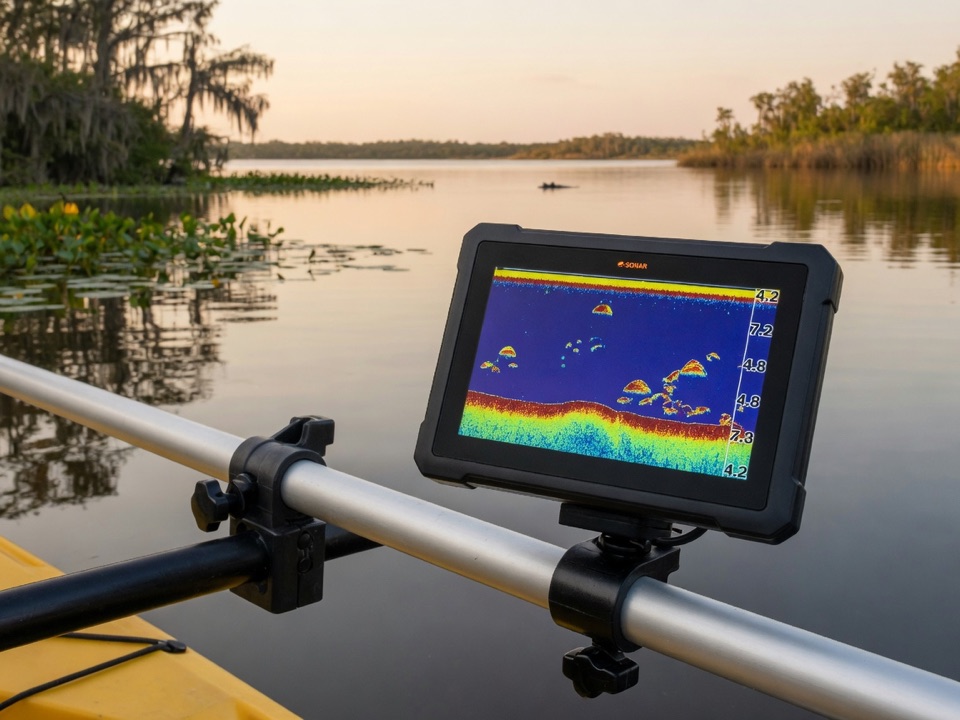
Even basic units reveal: water depth (critical for structure fishing), bottom composition (hard rock vs. soft mud), submerged vegetation (bass staging areas), and fish arches — the bowed echo signatures of suspended fish. For kayak and small boat anglers, a fish finder pays for itself on the first trip where you find a ledge you didn't know existed.
Types of Fish Finders
Traditional CHIRP Sonar
Sends a sweep of frequencies (not just one) for sharper, more defined fish arches and better target separation. This is the baseline standard for any unit worth buying. Look for CHIRP in the product name or specs.
✓ Best for: all-around freshwater and inshore saltwater
Side Imaging (SI)
Sends sonar sideways — covers up to 240 feet to each side of the boat in a single pass. Ideal for scanning large areas of Lake Okeechobee or reservoir flats quickly. Shows structure in near-photographic detail.
✓ Best for: large lake fishing, structure scanning, covering water fast
Down Imaging (DI)
High-frequency sonar aimed directly beneath the boat. Shows detailed images of what's below — individual fish hovering over structure, weedlines, and suspended schools. Pairs with traditional sonar for a complete picture.
✓ Best for: seeing exactly what's under the boat in detail
Live Sonar (LiveScope / ActiveTarget)
Real-time sonar that shows fish moving in real time — you watch a bass approach your lure and see the strike. This is the technology that revolutionized tournament bass fishing. It's expensive ($700–$1,500) but genuinely a game changer.
✓ Best for: serious tournament anglers and sight-fishing specialists
GPS Combo Units
Most modern fish finders include GPS with chartplotting — you see your position overlaid on a lake map or coastal chart. Essential for offshore fishing and navigating Florida's unmarked river channels safely.
✓ Best for: saltwater offshore, large reservoir navigation, back-country flats
Castable Sonar (Portable)
A hockey-puck-sized transducer you cast out on your line. Connects via Wi-Fi to your phone. Not as detailed as a mounted unit, but brilliant for kayak anglers, bank fishermen, and anyone who wants sonar without installation.
✓ Best for: bank fishing, kayak without mounting, ice fishing (not in FL obviously)
Budget Fish Finders — Under $150
These units won't have GPS or side imaging — but they'll absolutely show you depth, bottom composition, and fish arches. More than enough for dock fishing, casual bass fishing, and learning the water.
Garmin Striker 4
The Striker 4 is Garmin's entry-level unit and it's genuinely excellent. CHIRP sonar gives you cleaner fish arches than older units twice its price. The built-in GPS is a surprise at this price point — you can mark productive spots and navigate back to them. ClearVü provides that detailed downward view for seeing fish over structure.
The 3.5" screen is small but readable in shade. In direct Florida sunlight you may need to reposition it. Transducer mounts easily with the tilt/swivel bracket on a kayak or small boat. Setup takes 15 minutes.
The verdict: The best fish finder under $150. Don't overthink it at this price range — buy the Striker 4 and learn on it.
Humminbird Piranhamax 4
Humminbird's entry-level unit has a slightly larger screen than the Striker 4 and a simple, intuitive menu system. No GPS at this price, and the non-CHIRP sonar means slightly fuzzier returns — but for dock fishing and small ponds it does the job well. Popular in Florida for canal bass fishing and freshwater ponds.
Best for: Ultra-budget buyers who prioritize screen size over GPS and CHIRP.
Deeper PRO+ 2 Castable Sonar
Cast it out like a bobber and it streams sonar data directly to your phone via Wi-Fi. The Deeper PRO+ 2 creates actual GPS-tagged bathymetric maps of the water you're fishing as you walk the bank. For bank anglers on Florida's public ponds and canals, this is a revelation — you'll know the contour and structure of every spot you fish.
The app quality is excellent and it pairs reliably. Battery lasts 6+ hours. Some users find the small size (25mm diameter) means it gets blown around in wind — use a 1/4 oz weight to help it sink and track straight.
Best for: Bank anglers, kayak anglers without a good mounting spot, and anyone who wants castable sonar without boat installation.
Mid-Range Fish Finders — $150 to $400
This is where fish finders get genuinely powerful. GPS chartplotting, side imaging, larger screens, and networking capability open up. The sweet spot for most serious Florida anglers.
Garmin Striker Vivid 7sv
The Striker Vivid 7sv is the fish finder we'd recommend to most Florida anglers stepping up from a beginner unit. The 7" sunlight-readable screen is a massive upgrade in Florida's glary conditions. SideVü imaging lets you scan 100+ feet to each side — critical for finding hydrilla edges and submerged structure on Lake Okeechobee and the St. Johns River.
Garmin's Quickdraw Contours technology auto-creates HD bottom maps as you fish — your own private lake map that gets more detailed with every trip. The "Vivid" color palette makes fish arches pop off the display. Setup is genuinely plug-and-play; we had it running in 20 minutes on a bass boat.
Why Florida specifically: Side imaging is essential for scanning Florida's wide, shallow lakes where fish hold on grass edges. ClearVü shows hydrilla beds vs. bare bottom in the kind of detail that traditional sonar can't match. This unit earns its price on Lake Okeechobee alone.
The verdict: Best value in mid-range. The 7" screen, side imaging, and GPS combo is hard to beat at this price.
Humminbird HELIX 5 CHIRP GPS G3
Humminbird's HELIX 5 has one of the most respected screens in fish finders — razor-sharp 800×480 pixels makes reading arches and bottom structure easy. The CHIRP + Down Imaging combo covers the most common fishing scenarios in Florida. Autochart Live creates GPS-tagged depth maps like Garmin's Quickdraw.
Humminbird's interface is slightly more menu-heavy than Garmin's, but once you learn it, it's very capable. At 5" the screen is adequate — upgrade to the HELIX 7 if screen size is a priority. Strong brand reputation for reliability on bass tournament circuits.
Best for: Anglers who want Humminbird's ecosystem (compatible with their networking and trolling motors) or prefer the HELIX UI.
Lowrance HOOK Reveal 7x
Lowrance's HOOK Reveal series introduced "autotuning sonar" that automatically adjusts sensitivity as you move between different depths and bottom types — a real advantage for Florida's varied water (spring-fed clear water vs. tannin-stained rivers vs. murky inshore bays). The FishReveal feature overlays fish arches on top of the down imaging view, making targets easy to identify even for beginners.
C-MAP inland charts are included for Florida lakes and rivers — Okeechobee, Toho, and the St. Johns are all pre-loaded. Saltwater charts require a subscription but are excellent quality for Gulf and Atlantic coastal navigation.
Best for: Beginners who want a 7" screen, side imaging, and autotuning without having to learn how to adjust sonar settings manually.
Best Fish Finders for Kayak Fishing
Kayak fish finders need to be portable, battery-powered, and compact. Most kayak anglers run 5" or smaller screens to save space, and use a portable battery bank or dedicated lithium battery rather than a dedicated 12V system.
Garmin Striker Plus 5cv Bundle
The Striker Plus 5cv is purpose-built for kayak anglers. The 5" screen fits easily on a Ram mount arm on most fishing kayaks. It runs on 12V — connect it to a 12V lithium battery pack for a completely portable setup with no permanent wiring. One 6Ah battery runs it for 8+ hours.
CHIRP sonar and ClearVü down imaging make it genuinely capable for Florida kayak fishing — finding grass edges at 8 feet in Lake Toho, marking bass under docks at Silver River, checking depth before you commit to a wade. The Quickdraw mapping feature creates personal lake maps as you paddle.
Setup tip: Mount with a Ram Fish Finder Mount on your kayak's track or through-hull mounting point. Position it to the side of your tackle trays where you can glance at it mid-retrieve.
Deeper START Smart Fish Finder
For kayak anglers who want zero installation — no drilling, no wiring, no mounting hardware — the Deeper START is compelling. Clip it to your kayak's front end, trail it in the water, and stream depth and fish data to your phone. No battery required — it charges via USB.
The single frequency (no CHIRP) means less sharp returns than the PRO+ 2, and the 165 ft max depth is more than adequate for Florida's inshore and freshwater. Fine for casual kayak angling where you just want depth awareness and basic fish detection.
Fish Finder Buying Guide
Florida-Specific Fish Finder Tips
🌿 Set Grass Reject to Medium
Florida's lakes are choked with hydrilla and eelgrass. Set your sensitivity to filter out light grass returns while still showing fish holding inside the grass. Too high sensitivity = all green, no useful information. Most Garmin units: Auto sensitivity with "Fishing Mode" handles this automatically.
🌊 Florida's Waters Are Shallow — Don't Dismiss Low Depth Numbers
Lake Okeechobee averages 9 feet deep. Lake Toho is often 10–14 feet. Even at these depths a fish finder is invaluable — it shows you grass bed edges, shell bars, and the 2-foot depth change that separates where bass hold from where they don't.
🎣 Mark Waypoints Obsessively
When your fish finder shows a brushpile, a depth change, or a grass edge — mark it. Go back to those spots. Florida's bass fishing is significantly about pattern fishing across structure, and your waypoints become a private map of productive water.
🌡 Use Water Temperature
Most fish finders with a transducer also read surface water temperature. In winter, warmer pockets (springs, warm-water discharge from power plants) concentrate bass. In summer, look for cooler water near spring-fed areas. Temperature can be as important as depth.
🦟 Rinse After Every Saltwater Use
Flush the transducer cable connectors and bracket with fresh water after every saltwater trip. Salt corrosion on connector pins causes intermittent signal loss and is the #1 cause of fish finder failures in Florida saltwater use. A 30-second rinse prevents it entirely.
Product links are Amazon affiliate links. As an Amazon Associate, we earn from qualifying purchases — at no extra cost to you. Learn more →